FIRST Tech Challenge · Team 2845 · 2025–26
Turret Aiming and Launch Control
Aiming by turning the whole robot fell apart under defense, so we added a turret. My first launch model fitted flywheel speed to the camera’s view of the goal; it worked until the robot moved. The second one aims from odometry and uses the camera only to stay honest.
2025–2026 · Tampa, FL
Java · Limelight · Curve Fitting · Motion Prediction
The Problem
In the 2025–26 game, robots launch balls into a goal. We started by aiming the whole robot at it, but that fell apart as soon as other robots played defense and pushed us off target. We added a turret, and the software’s job became keeping it pointed at the goal and picking the right flywheel speed from anywhere on the field.
First Attempt: Camera-Based Curve Fit
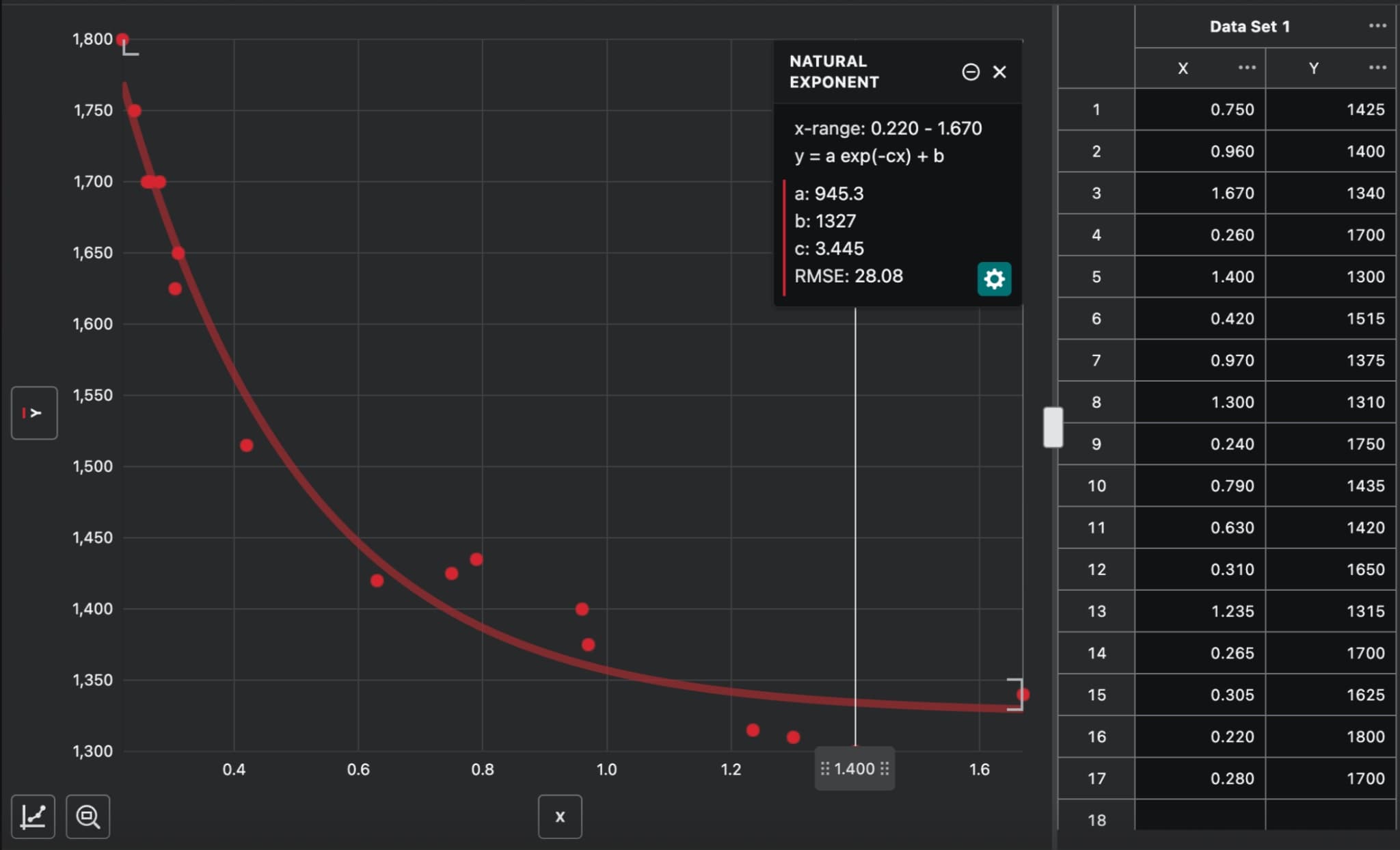
My first model used the camera alone. The goal’s AprilTag takes up less of the image the farther away it is, so I drove to 17 spots, recorded the tag’s area and the flywheel speed that scored from each, and fit a curve:
v = 945.3 · e−3.445 · a + 1327
a is tag area as a percentage of the image, and v is flywheel speed in encoder ticks per second. The fit’s RMSE was 28 ticks per second.
Failure Mode and Redesign
It worked, but only while the camera could see the tag, and tag readings get unreliable when the robot is moving. In a real match the robot is almost always moving.
So I flipped the roles. The final code aims from odometry: the robot keeps the goal’s position in its own field coordinates and points the turret at it every loop, whether the tag is visible or not. The camera keeps that estimate honest. When it sees one of the goal tags while the robot and turret are nearly still, under 2 in/s and 5°/s, its pose estimate re-anchors the goal’s position. Readings taken while moving are ignored.
That left one more problem. A ball launched from a moving robot keeps the robot’s velocity, so aiming straight at the goal misses. The code estimates how long the ball will be in the air from its distance, moves the robot’s predicted position forward by velocity × flight time, recomputes the distance, and repeats five times so the estimate settles. The turret and flywheel then aim from that predicted position. I checked the geometry in a small desktop simulation of the same math before running it on the robot.
The game also requires scoring balls in a color order revealed at the start of each match. Color sensors around a three-slot spindexer track which ball is in each slot, so the robot can rotate the right one into the launcher.
Result
The turret tracks the goal with or without the tag in view, the flywheel speed follows distance automatically, and the robot can score while driving instead of stopping to line up.